

Years in a salon give you a valuable starting point: practical grooming skills, experience handling different dogs and an understanding of what clients expect.
But owning a mobile business adds responsibilities a salon may previously have handled for you: licensing, insurance, maintenance, wastewater disposal, scheduling, pricing and finding customers.
The smartest first purchase is not necessarily a van. It is a clear operating plan.
This guide is educational, not legal, tax or insurance advice. Requirements depend on your location and activities. Confirm current rules, fees and coverage directly with the relevant agencies and qualified advisers. Links are provided as research starting points, not proof of approval.
Los Angeles County does not mean one set of permits
Your business may be based in the City of Los Angeles, another incorporated city or an unincorporated part of the county. Your operating base, van-storage location and service cities all matter.
LA County Animal Care and Control includes mobile groomers in the businesses it regulates within its jurisdiction. The City of Los Angeles has its own animal-business permit provisions. Do not assume either approval covers every city in the county. County guidance · City permit provisions.
Then check each city you plan to serve. Postal addresses alone do not establish jurisdiction.
Your first-call checklist
- Which authority regulates mobile grooming at my base address?
- Does the van need an animal-business permit and inspection?
- What registrations are required in each city I will serve?
- May I park and store the van at home? Check zoning, parking, lease and HOA restrictions where applicable.
- Where may I legally dispose of grooming wastewater?
- Are there generator, noise or street-operation restrictions?
Keep written answers, agency contacts and application links in one startup folder.
Separate business registration from grooming approval
Registering a company does not automatically approve a grooming operation. Decide on your business structure with a qualified adviser, considering liability, taxes, administration and ongoing costs.
Business setup
- Choose your structure and business name.
- Complete entity and fictitious-name filings where applicable.
- Obtain an EIN where applicable.
- Open a separate business bank account.
- Confirm local registrations and tax accounts.
Operating approval
- Confirm mobile grooming permits.
- Ask about inspections and operating standards.
- Check required records and displayed documents.
- Confirm fees, renewals and service-area requirements.
For a fictitious business name, follow the County Clerk's current filing and publication instructions. A name filing is not an animal-business permit. LA County name-filing guidance.
The City of Los Angeles Office of Finance states that businesses operating within city limits must file for a Business Tax Registration Certificate. This is separate from animal-business approval. Check City of Los Angeles registration.
Insure the work you actually perform
Explain that you will groom animals inside a converted vehicle. Describe the equipment, drivers, storage location and any pet transport or employees. A policy called "business insurance" may not cover every important risk.
| Coverage | What to clarify |
|---|---|
| Commercial auto | Business driving, authorised drivers and vehicle use. |
| General liability | Third-party injury and property damage. |
| Grooming / professional liability | Claims arising from grooming work. |
| Animal care, custody or control | Injury, loss or death of animals entrusted to you. |
| Equipment / property | Built-in conversion, removable tools, theft and damage. |
| Business interruption or related protection | Qualifying events, exclusions and waiting periods; do not assume breakdowns qualify. |
| Workers' compensation | Obligations when hiring employees. |
"Does this policy cover an animal injured during grooming, and where does it say that?"
Coverage names, exclusions and limits vary. Do not assume general liability covers animals in your care or a vehicle policy covers the full conversion. California commercial insurance guide.
California generally requires workers' compensation when you have even one employee. Confirm the rules for your ownership and staffing arrangements. California employer requirements.
Choose the van for its systems, not just its looks
A beautiful interior does not prove that a van is mechanically sound or suitable for your route. Arrange an independent mechanical inspection and a qualified assessment of the grooming conversion before purchasing.
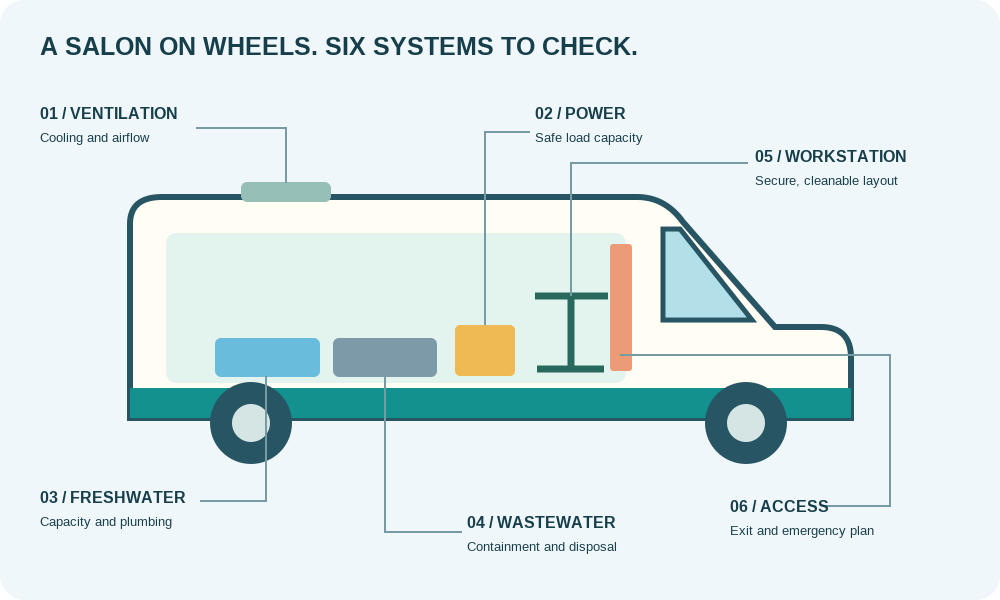
Vehicle inspection
- Title, ownership and liens.
- Maintenance history and mileage.
- Tires, brakes, suspension and leaks.
- Loaded weight and remaining payload.
- Registration, emissions and commercial-use requirements for that vehicle.
Grooming-system inspection
- Tanks, plumbing, drainage and water heating.
- Electrical capacity and protective devices.
- Air conditioning and ventilation.
- Generator or battery condition.
- Secure equipment, non-slip flooring, emergency access and shutoffs.
Request a working demonstration: run the dryer, air conditioning, lights and other expected equipment together. Have a qualified professional assess whether the system can safely support that load.
Plan for hot weather and equipment failure while an animal is inside. Do not leave this decision until your first busy day.
Continue: Used grooming van buying guide →Cleaning and wastewater are part of the business
Schedule time for hair removal, cleaning and disinfection, separating clean and used towels, water refilling, approved wastewater disposal and equipment checks.
LA County publishes grooming-operation standards covering sanitation and animal safety. Ask your regulator which provisions apply to your operation. County grooming-facility guidance.
Claremont publishes mobile-groomer wastewater guidance, illustrating why local instructions matter. Do not assume that a disposal location or method is approved without confirmation. Claremont wastewater guidance (PDF).
Price the whole appointment, not just the haircut
Account for travel, parking, handover, cleaning, refilling, fuel, insurance, maintenance, administration, payment fees, cancellations and vehicle downtime. Salon prices may not translate directly to a mobile operation.
What would your average visit need to earn?
Hypothetical figures only. These are not Los Angeles market rates or a recommended price.
- Monthly business operating costs
- $4,000
- Owner compensation target before personal taxes
- $5,000
- Maintenance and contingency allowance
- $1,000
- Required monthly revenue
- $10,000
Replace every assumption with your actual costs and realistic capacity. Avoid double-counting maintenance; budget for variable costs, taxes and profit goals. Have an accountant review your model.
If selling products too, confirm seller's permit and tax obligations with CDTFA or your accountant. Services and retail products should not automatically be treated alike. CDTFA service-business guidance.
A busy calendar is not necessarily a profitable calendar.
Start small and build a sensible route
Choose a manageable cluster of neighbourhoods rather than advertising everywhere. Measure driving, parking, grooming and cleanup time before expanding.
Scattered appointments
More cross-city travel and less predictable arrival windows.
Clustered appointments
Nearby stops make a more manageable starting route.
- Assign nearby neighbourhoods to the same days.
- Set clear service boundaries and travel buffers.
- Rebook regular clients into geographically sensible slots.
- Use realistic arrival windows instead of promises the route cannot support.
Prepare client policies and safety records
Before your first appointment, prepare intake and service documents covering:
- Owner and emergency contact details.
- Health, behaviour and handling concerns.
- Vaccination documentation required by your regulator or business policy.
- Grooming instructions and agreed scope of service.
- Matting and additional-work policies.
- Arrival windows, parking and property access.
- Cancellation, no-show and payment terms.
- Emergency veterinary authorisation.
- Separate permission for marketing photographs.
Obtain suitable professional advice on your terms. A signature does not replace safe handling or insurance. Do not publish client or pet photographs without the necessary permission.
Launch gradually and measure actual capacity
Once approvals and insurance are in place, start with a small number of paid appointments. Track grooming time, driving and parking, cleaning, water and power use, collected revenue, equipment problems, cancellations and rebooking.
Use the results to adjust your schedule before filling every slot. Respect your existing employment obligations and do not take confidential salon records or customer lists.
Ready to move from salon to mobile?
Use these checkboxes while planning. Selections are temporary and are not saved. Your browser's Print menu can print the guide and checklist.
Editorial note: This guide is independently written by PawsRoute and is not affiliated with or endorsed by the agencies linked above. Requirements may change. No individual from a private social-media discussion is identified.